What 25 Years of Fathering Three Very Different Children Taught Me About Strengths

A reflection on fatherhood, family profiles & the moments that changed how I saw my children (and myself).

#achiever  #developer  #maximizer  #strategic  #ideation  #adaptability  #competition

 

My daughter was 15 when she asked me one of the most disarming questions I’ve ever received as a father.

She asked whether it was ok for her not to go to Junior College. Whether she could, instead, pursue design at a polytechnic - Early specialisation. A different path from the rest of the family.

And I’ll be honest: my first internal response was not calm.

I thought about future earning potential. I thought about the fact that her older sister had achieved exceptional academic results. I thought about what it would mean if she stepped off the path the rest of us had walked. My #achiever wanted measurable outcomes. My #analytical & #deliberative mind ran the risk assessment.

And then I remembered that she had asked that question after taking her CliftonStrengths assessment. She had language for herself that most 15-year-olds don’t have. And she was placing that language alongside what she loved.

 She wasn’t asking me to lower the bar. She was asking me to find the right bar for her.

That moment changed something in me as a father. It is the moment I keep returning to when I think about what strengths-based parenting actually means (not as a theory, but as a decision with weight).


THE FRAMEWORK THAT CHANGED EVERYTHING 
I’ve spent 12 years as a Gallup-certified Strengths Coach, working with individuals, teams & orgnsations across Singapore. The tool of choice is CliftonStrengths (a psychometric assessment that identifies 34 talent themes: patterns in how a person naturally thinks, feels & behaves).

What makes CliftonStrengths different from most personality frameworks is the granularity. It doesn’t put you in a box. It gives you a ranked fingerprint (34 themes, in a unique sequence, specific to you). No two profiles are exactly alike & that specificity matters - because it means you stop describing people in broad strokes & start seeing them in precise ones.

In my professional work, the moment I consistently watch for is when someone reads their profile & says “yes – that’s exactly me” - something shifts. They stop apologising for how they’re wired. The person who always needs more time to decide realises they’re not slow (they have strong #deliberative). The person who can’t stop generating ideas realises they’re not unfocused (they have strong #ideation). The framework turns self-criticism into self-understanding.

What I didn’t fully anticipate, when I started this work, was how much it would change me as a father.


THREE CHILDREN. THREE COMPLETELY DIFFERENT WIRING DIAGRAMS.

My wife & I have three children (now 25, 23 & 17) & if I’m honest, before I had a strengths framework, I was parenting all three of them through onelens: mine.

My dominant themes are #achiever, #ideation, #strategic & #analytical. I am wired to drive forward, generate possibilities & measure progress. Left to my own instincts, that’s what I would have pushed my children toward as well.

But the profiles told me that each of my three children is wired almost entirely differently from the others (& in several key ways, differently from me & my wife).


My Eldest: Learning to Read a Language I Didn’t Speak

My eldest daughter’s dominant themes include #adaptability, #empathy, #intellection & #developer. She is present-moment oriented, deeply reflective & attuned to people. She grows others almost instinctively.

Her #achiever sits at position 32 out of 34. My #achiever sits at position 1. You can imagine the early friction.

My instinct was to push her towards excellence (to ask what she was working toward, to measure progress, to encourage drive). But that’s not how she flourishes. She flourishes by being present, by understanding, by investing slowly & deeply in people over time. Pushing her toward my pace wasn’t helping her. It was asking her to perform in conditions that worked against her nature.

What I had to learn (& it took longer than I’d like to admit) was that her way of being in the world was not a slower version of mine. It was a completely different & equally valid version of excellence. My job was not to redirect her toward my pace. It was to expand my definition of what flourishing looks like.

I didn’t need to fix her. I needed to broaden myself. 

My Middle Child: The Moment I Said Yes

This brings me back to that conversation when my second daughter was 15. Her dominant themes: #communication, #maximizer, #ideation. She is expressive, excellence-oriented & deeply creative.

In secondary school, she struggled like many other creatively-wired children do when the curriculum doesn’t fit their strengths. Her results were solid (around the 75th percentile), but the conventional academic path wasn’t where she came alive.

When she asked me that question, she wasn’t asking me to lower my expectations. She was asking me to “locate the right expectations”. When I held her #maximizer (which doesn’t do average, which drives toward exceptional) alongside her #ideation & her love of design, something clicked.

#maximizer doesn’t settle for mediocrity. It takes something already good & pushes it toward great. Together with #ideation, it’s the core competency in a design context.

I said yes & I’ve watched her build something genuinely excellent in the years since.

The most loving thing I could do was let her be excellent in her own direction (not mine).

My Son: Understanding Why He Walked Away

My youngest (now 17) leads with #strategic, #input, #analytical & #learner. He is a thinker. Precise, pattern-oriented, quietly formidable - he processes internally.

For a while, he played basketball (the game I love). Then he stopped. He didn’t want to continue on the team.

A father with high #achiever may read that as lack of grit. Push through. Don’t quit. But when I understood his #competition theme (which in CliftonStrengths is specifically about winning relative to others, not simply about effort) I saw it differently.

People with strong #competition don’t play for the experience. They play to win. And if winning isn’t a realistic outcome, the activity loses its meaning. My son had done the #strategic-#analytical calculation. He assessed the court & concluded he couldn’t win there. Walking away wasn’t a failure of character. It was, in fact, clear thinking.

I needed to understand his wiring before I could respond well to his decision. That sequence (understand first, respond second) is the one I would have gotten wrong as a younger father.


WHAT I WISH I’D KNOWN EARLIER

If I could write a letter to my younger self (the father I was in those early years before I had this framework), I’d include three things that would have changed how I showed up. 
1.  Other people’s wiring is not a problem to fix. It’s a language to learn.

I spent years trying to redirect my eldest toward my pace. What I was actually doing was refusing to learn her language. The gap I was trying to close wasn’t in her. It was in my understanding of her.

2.  The most dangerous thing you can do as a parent is make your definition of success the default setting for someone else’s life.

When my second daughter asked to take a different path, I had to consciously unhook my definition of success from hers. That is harder than it sounds when your own #achiever is running the show.

3.  When your child stops, look at the thinking before you judge the stopping.

The response that matters most as a parent always comes after understanding (not before it). My son’s decision to leave basketball was precise & intentional. I almost missed that entirely.

THE THING ABOUT THE BOTTOM OF THE PROFILE

Here is something else most people don’t talk about with CliftonStrengths: the bottom of the profile is just as informative as the top.

We tend to focus on what people are. But knowing what someone is genuinely not wired for is equally clarifying & often the more immediately useful insight in parenting. Because the instinct to push a child toward what they lack is a very natural one & that can do a lot of quiet damage.

My eldest, for example, has #achiever at 32 & #competition at 25. Pushing her to be more driven, more output-focused, more competitive (which would have come naturally to me) would have been asking her to operate against her grain. It will not be her growth edge. Rather it is a total mismatch.

My son has #command at 32 & #significance at 33. He is not wired to seek visibility, to lead from the front, or to be motivated by how others see him. Nudging him toward conventional markers of teenage leadership (school prefect, team captain, speak up in class) would have been nudging him away from himself.

The bottom of the profile doesn’t show you what your child needs to fix. It shows you where to stop pushing — and start listening for a different kind of signal.

That shift (from asking “why aren’t you more like this” to asking “what does this tell me about where they actually thrive”) is one of the quietest & most important moves a strengths-based parent can make.

A QUESTION FOR YOU

 If you’ve read this far, you’re probably a parent (or someone who was once parented) who has felt the quiet tension of being seen through someone else’s lens. So here’s what I’d invite you to sit with:

Which of your children (or the child you once were) have you been trying to understand (and which have you been trying to redirect)? What might change if you spent one week simply observing, without trying to improve?

Parenting doesn’t get easier the longer you do it. But I do think it gets more accurate (if you’re willing to keep learning the language of the people you love most).


If this resonated with you, 

I'd be delighted to hear from you. Whether you're a parent curious about your family's strengths profile, or an organisation exploring strengths-based development, drop me a note at yeangcherng.com or visit strengthstransform.com to find out more about our programmes.

The journey of understanding yourself (& the people you lead, love & live with) is one worth taking intentionally.

Tags:

#CliftonStrengths  #StrengthsBasedParenting  #FathersDay  #FamilyStrengths  #StrengthsTransform  #Singapore  #Coaching

Mastering Self - Optimal use of strengths

A most positive, lively, empathetic, creative & understanding person

“I’m actually a very judgmental person!” - Sarah exclaimed to me.

This marked a significant personal discovery she made after scrutinising her dominant talent themes. By all accounts, Sarah was a person that most people will love as a friend - positive, lively, empathetic, creative, understanding. “Judgmental” will be hardly be the word used to describe her.

Yet as we journeyed together for personal transformation, it was quite clear to her that the things that she is most sensitive to becomes the very lenses she uses to evaluate the world.

  • #empathy - naturally notices people’s body language, tone of voice, micro-expressions

  • #developer - sensitive to whether people are keeping up with a certain pace

  • #arranger - instinctively sees how best to juggle multiple priorities & optimise moving parts

  • #communication - notices where things could have been said in a better way

  • #strategic - sensitive to alternative paths & options that are more direct

We can go on and on, through each of the 34 talent themes and highlight how talent themes show us what we are most sensitive to. However, how does that translate to becoming “judgmental” - either intentionally or unconsciously?

What we are sensitive to becomes very evident when seen through our lenses - yet these are the very things that people with other talent themes cannot see naturally (because they see through OTHER talents & lenses). For example:

  • Sarah notices a colleague feeling down & left out (#empathy). Another colleague misses this and proceeds to make an (unintended) insensitive statement. Sarah’s thought process could go this way “this is so obvious! how did you even miss her feelings?”

  • My dominant talent #strategic helps me identify a more direct route towards solving the problem at hand. Another colleague takes a bit longer time & I may be thinking “how do you even fail to notice that we are going “round-about”?”

In each case, the very talents that enable us may become the very talents that make us judge others! This is not the “use-case” for discovering our talents. The optimal use of our talents occurs when we use it to serve others, not to judge others!

When I finally understand what others can see (corresponding with what I can’t see - for example my lesser themes), I am always hopeful that people help me look out for these instead of using these to judge or evaluate me.:

  • #includer - I don’t naturally notice people who are left out & marginalised - please help me!

  • #harmony - I don’t naturally notice tension in the room - please remind me!

Strengths coaching & organisation development breaks down, when people stop at seeing their dominant talents as a mark of superiority - and do not proceed to use it to serve others.

What are our biases? How do we judge the world around us? What does our CliftonStrengths profile tell us about the way we are judging others?

Likewise, when people are led to serve others with their dominant talents, & inviting others to serve them in their blind spots, a stronger interdependent organisation emerges.

Who do we serve with our dominant talents. Who do we invite to serve us?


Written by Poh Yeang Cherng (Achiever . Ideation . Relator . Strategic . Analytical . Learner)

Yeang Cherng is a Gallup-certified & Newfield-certified coach who focuses on helping clients, organisations, and communities reach their full potential through “strengths-transformation”. With significant experience in education and people development, he uses a unique method that identifies & utilises individual strengths for personal and professional growth. He also works with teams & leadership to “align strengths to eliminate weaknesses”. Yeang Cherng believes in strengths-based development as a way to create positive change and lasting impact.

StrengthsFinder Coaching: Harnessing Power of Unique Profiles

No Ordinary Organisation

StrengthsFinder Coach - Harnessing Uniqueness.jpg

I walked into a busy healthcare facility in the heartland of Singapore. The security guard initiated surprising hospitality-like eye contact and asked me what I needed (not part of his security job!). I said "I have a meeting with Dr. X" (certainly not your usual visitor request in a healthcare facility).

Surprisingly, he walked me personally to the door of Dr. X, checked for his presence in the room, before allowing me to contact Dr. X on my mobile.

During the 10min waiting time before I met Dr. X, two other staff approached me to see how they could assist me (they were obviously paying attention to my "non patient-like" body language)

A Unique Work Culture

That surprised me. This was no ordinary work culture.

THAT was no ordinary security guard (not even an employee of the organisation, merely contracted to provide security services). But his hospitality spoke volumes about how psychologically invested he was in his job.

There were many other patients in the healthcare facility, all presumably waiting. The three personnel's actions demonstrated the amazing level of staff engagement in this place. There was nothing that happened that didn't concern anyone. No one had to wait for others before taking action to serve.


The Man Behind the Culture

Dr. X came across as humble, polite & patient, not the usual qualities you will immediately associate with a successful & accomplished leader of a healthcare facility. He said,

"Here we treat everybody, even non-employees (referring to the security guard) as part of the family. They get invited to all our staff functions and gatherings. People here stay a long time, they do not want to leave."

He was speaking about what he did, but I was making connections between his actions and the talent themes on his most unique profile.

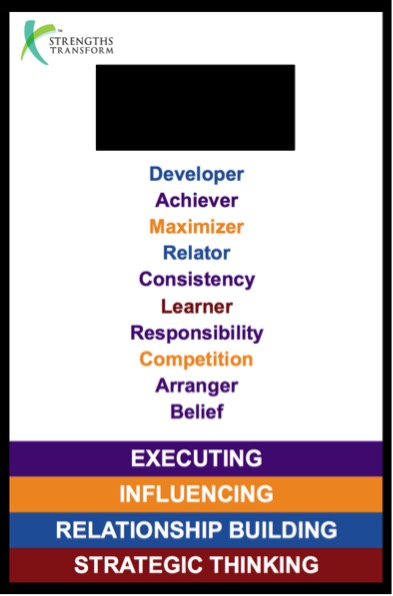
Developer-Maximizer

Strengths-Based Coaching by StrengthsTransform

Strengths-Based Coaching by StrengthsTransform

Dr. X possesses a unique ability to focus on incremental improvement (#developer) of his people while pushing for high standards (#maximizer). This allows him to patiently nurture junior staff yet engage high-flyers to drive excellence. No one left behind.

Arranger-Achiever-Responsibility

He does work well independently (#achiever), yet is adept at delegation (#arranger), all these while maintaining a real ownership of everything that happened in his center (#responsibility). An effective manager who leads from the front.

Consistency-Relator

He invests time fairly among his huge staff team (#consistency), yet manages to make all of them his inner circle (#relator). People felt close to him without sensing any favouritism or cliques. Relatable leader to all staff.


Keys to Effectiveness - Applying Talents for Consistent Positive Outcomes

StrengthsFinder Coach - Harnessing Uniqueness.jpg

We could go on about the half-dozen combinations we explored during strengths-based executive coaching, but it was clear that Dr. X's excellence arose from his ability to apply contrasting talents effectively to meet the multi-faceted demands on a healthcare leader.

Dr. X demonstrated an ability to use his unique soft-skills, coupled with his domain knowledge and skills as a medical doctor, to become an effective leader.

The Strengths-Based Coaching helped him to become aware of what he did (unconsciously) to become so good at his job. What was formerly incidental, once brought into conscious space, paves the way for intentional development & application.


Strengths-coaching now empowers him to do more:

  1. Selectively add more hard skills & knowledge to expand contribution into other areas (e.g. medical research)

  2. Intentionally maximise contribution with job functions that bring out his best soft-skills (a.k.a. career planning, people management & job redesign)

The coaching will have sparked a potentially significant leap, helping him to contribute even more.


Strengths-Based Leadership & Employee Engagement

That was all about the man. What had it to do with the staff & excellent culture? Even before executive coaching, Dr. X had already exhibited a keen awareness to engage staff in their (respective) unique talents.

  1. His #developer allowed him to engage people at their level.

  2. His #maximizer enabled him to focus on staff's potential for excellence.

  3. He invested time (#relator) to be curious about his employees (#learner) & assumed ownership (#responsibility) to assign roles (#arranger) so that his facility & service matches up to the highest benchmarks (#competition).

Gallup's research on employee engagement shows that a focus on strengths is the primary driver for staff engagement regardless of the bigger environment or the personal factors. Dr. X "just happened" to lead using a strengths-based approach even without calling it out.

Team Building StrengthsFinder.jpg

What did he do with this conscious realisation? He ordered StrengthsFinder profiling & StrengthsTransform Team Coaching for his staff.

(For more information about my coaching & training services. Please drop me a note or refer to the StrengthsTransform, Amplitude (corporate) or Kingmaker (schools) websites.)

Your Unique Talents - Keys to Power, Purpose & Passion in your Career

(An article I am writing for a dear friend's mission to value-add to the gig economy. And for everyone out there who is on the journey to discover your unique personal branding & contribution)

StrengthsFinder Career Coach.jpg

Key Questions for the Independent Talent

  • Q1: Why should customers & clients choose us?

  • Q2: What sets our service apart from the rest of the market?

These are key questions that face the successful Independent Talent (IT) everyday. The answer involves identifying how one can "uniquely value-add" to customers & clients, then elevating the service to become a "compelling draw" for clients.

Operating with Talent

"Unique value-add" happens when one does a job with his/her unique talents. Using Clifton StrengthsFinder terminology, "Talent" is defined as a naturally recurring pattern of thinking, feeling & behaviour.

When one operates with his/her "talent", it taps into a naturally stronger ability & competence for the task. It expends less energy because it is not contrived - resulting in greater enthusiasm & energy. The service becomes better value for the client. When successfully sustained over time, it carves a clear niche highlighting the best that one can offer to the world - a unique value-proposition.

Thus if any person is able to find, create or shape a job that maximises all of one's dominant talents – he/she will probably have found the lead to an ideal, all-consuming career - one marked with excellence, productivity & engagement.

Talents & My Career

My top 5 StrengthsFinder talents are (1) Achiever (2) Ideation (3) Relator (4) Strategic (5) Analytical. The profile describes & identifies very accurately the highlights & valleys of my career:

  1. Highlights - when I design intellectual property (#ideation, #strategic, #analytical) for a nationwide thrust for cyber wellness education

  2. Valleys – when I struggled to use my #relator talent (as an engineer) & #achiever talent (as a manager in a big hierarchical organisation)

Today, I am a Strengths Coach for professionals & students, imparting the very same insights that transformed & continually shapes my career. Everyone’s primary goal should be to identify one's talents, to intentionally develop & operate with them.

Launch Your Strengths-Based Career

Purchase your profile & get a complimentary 15min consultation, visit this link


Coaching "Unusual" StrengthsFinder Profiles II

An 18 year old student got her StrengthsFinder profile. After scrutinising her Strengths Reports, she approached me with a troubled look at the end of a Strengths Introduction session.

StrengthsFinder Profile Poh Yeang Cherng

"I'm unsure about these three talent themes - they don't seem to describe me"

#activator #individualization #deliberative

STEP #1: Define Talent Themes Precisely & Concisely

I asked...

(1) "What do you understand by these three themes?"

  • to check for for her understanding
StrengthsFinder Coaching Poh Yeang Cherng

"Signature Themes Report” covers the broad spectrum of thinking, feeling & behaviour patterns.


"Strengths Insight Report” customises theme descriptions with other signature themes.


Some people are still unable to pinpoint & confirm their top 5 with these reports. In such cases, it is imperative that coaches are able to provide concise & precise descriptions for the themes.”

(2) (Hearing her understanding) "That is partially true, but a more direct way to explain this is..."

  • #activator - "hate to wait" & "try first & learn along the way"
  • #individualization - "easily notices preferences of people & caters to each with different approaches"
  • #deliberative - "naturally sees risks, thinks of what may go wrong & takes precautions"

(3) "When do you think, feel or behave that way?"

  • Check whether they can clearly & concretely identify manifestation of talent themes

(4) "That sounds right. You do manifest these talent themes. Why did you feel (2 minutes ago) that it doesn't describe?"


STEP #2: Discern for Contrasts & Unlikely Pairs in Top 5

(5) I notice contrasting pairs of themes in your top 5. Do you recall situations where you vacillate between the talent themes?

  • #activator usually wants to start & get things off the ground. However #deliberative may prefer to carefully consider risks before starting.
  • #command usually wants to take charge and lead people to follow your decision. However #individualization prefers to cater to & adjust to people's preferences.
Bullseye.jpeg

Spot on!

The lady could identify many situations where she felt "torn". It was because of these situations that she found it hard to accept that she had #activator #individualization & #deliberative


StrengthsFinder Coaching

Do you have inquiries & doubts over your StrengthsFinder report? You can contact a StrengthsTransform™ Coach to guide you through this process of identification!

StrengthsTransform™ Coach Certification

Interested in getting certified to use our tools & materials for coaching? Inquire with us for the next run of training!

Coaching "Unusual" StrengthsFinder Profiles

Perfecting Self-Discovery with StrengthsFinder

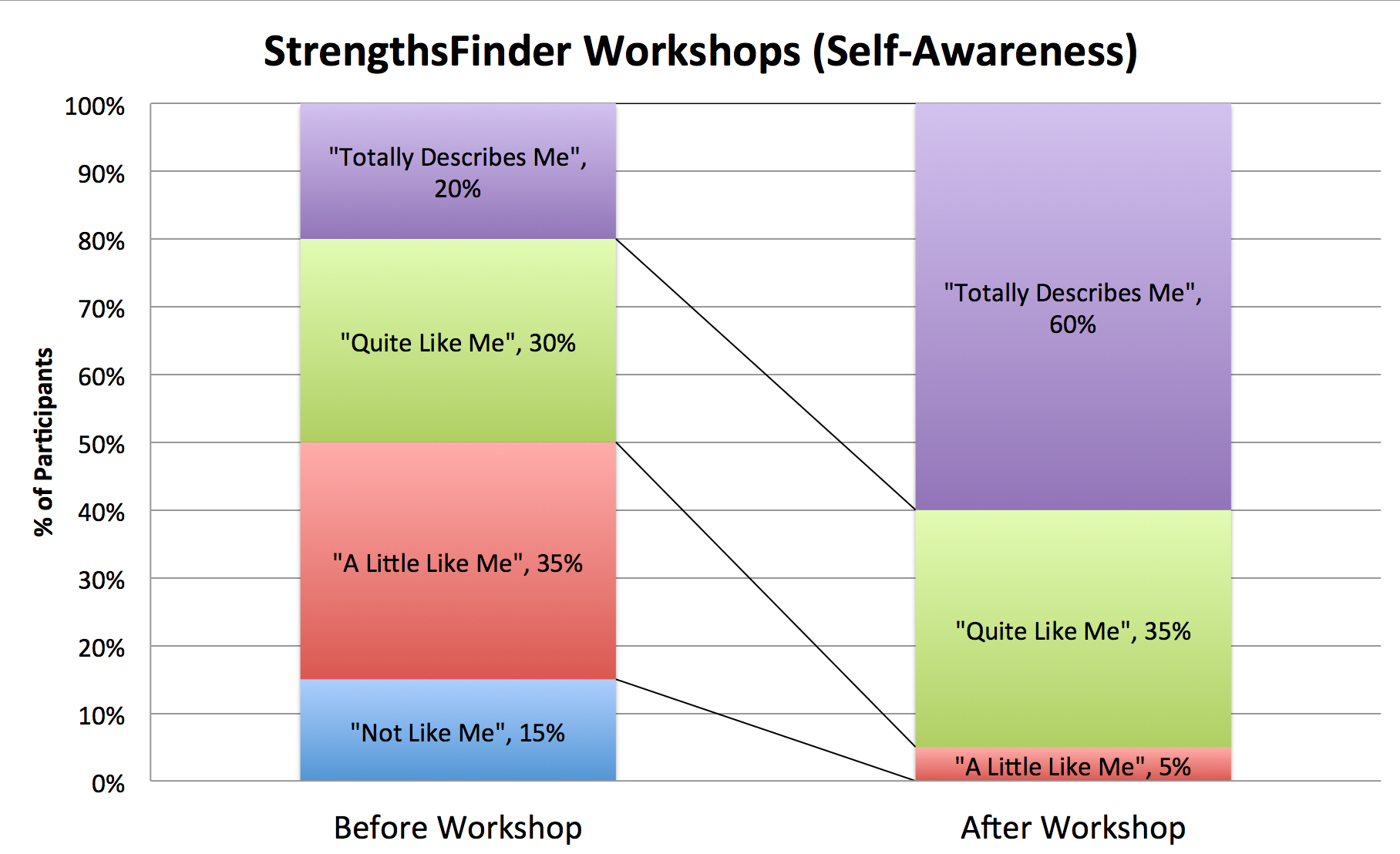
At the beginning of every Strengths Discovery Workshop, after reading their StrengthsFinder reports, participants usually indicate the following:

  • 15% - "not like me"

  • 35% - "a little like me"

  • 30% - "quite like me"

  • 20% - "totally describes me"

By the end of the sessions however, with precise explanation & interview, most people will gravitate towards

  • 0% - "not like me"

  • 5% - "a little like me"

  • 35% - "quite like me"

  • 60% - "totally describes me"

StrengthsFinder Coaching Self-Awareness

I've discovered that the remaining 5% are uncertain, usually due to a combination of factors:

  1. Disruption during profiling (somewhat inevitable)

  2. Inherent issues with StrengthsFinder profile (although it already is, in my opinion, the best instrument available)

  3. "Unusual" profiles (varies with clients)

  4. Younger clients (who may lack the depth of social experience to relate to the descriptions)

Diagnosing "Unusual" Profiles

Although each of the 34 StrengthsFinder Talent Themes are distinct & independent, there exists some highly-unlikely pairs. Examples of these will be:

Contrasting StrengthsFinder Themes
  • Restorative-Maximizer

  • Strategic-Consistency

  • Command-Harmony

  • Analytical-Belief, Analytical-Connectedness

When some of these pairs occur in a single person's profile, they may struggle to identify with either of the themes they are so contrasting (and yet they also show up at the same time.

Examples of Unique Profiles

A recent client had trouble identifying with her command (#3) & harmony (#4) themes. It was only after a conversation she was able to identify that she is usually compromising when unless someone challenges her in a hostile situation. She said:

I am usually quite agreeable (#harmony). However when someone behaves rudely in traffic and cuts into my lane when I am driving, I usually with pursue the person and make sure I give him/her a piece of my mind (#command)!

Talk about contrast! Another example belongs to me:

My Analytical (#5) contrasts with Belief (#8) & Connectedness (#10). I have always been a sceptic and will find myself always asking difficult questions to discover the root cause of issues, seeking proof & explanation (#analytical). Yet with my faith-based teenage development, I learnt to embrace the unknown, the unexplained (#connectedness) and stand firmly by principles & values (#belief) that undergird my decisions.
So my faith (#connectedness, #belief) exists together with my doubt (#analytical).

Similarly, the person with #restorative and #maximizer may be selective (for quality), yet somehow be willing to work with the broken/struggling. The person with #strategic pushes for quick expedient solution yet is constrained by desire for fairness & equity.

Coaching Clients with Unique Profiles

StrengthsFinder Coaching

It is imperative that StrengthsFinder coach avoid taking a predictive ("I think you are like this"), prophetic ("see I told you") or even prescriptive ("people with this theme behave like this") approach to helping clients discover their strengths. Doing so will draw us dangerously close to "labelling" clients as a certain type (even though 34 types are pretty diverse).

I've learned to take a learning & inquisitive approach, always asking good questions and taking an attitude of "what else can I discover" about you? Using the theme descriptions as a starting point, I ask them to

  1. Point out the statements which best describes them.

  2. Ask them to elaborate how descriptions show up in their life

When there are doubts or uncertainly, I suggest how some other themes may modify their behaviour somewhat, yet always leaving room for them to disagree or to add on to my suggestion.

Here the coach becomes a learner, and continually develops in using the StrengthsFinder language to describe the amazing complexity in humankind!

Coach Development with StrengthsFinder

Unlikely pairs are some of the first things I look out for when preparing for workshops or coaching sessions. Being ready puts me into a position where I can help clients better. But many times, I also have to depend on quick thinking on my feet in order to respond to such cases.

I hope this has been helpful to you. If you are looking to dialogue further on other tips for coaching, or are interested in attending our continual coach development sessions with StrengthsTransform(TM), drop me a note and I will be delighted to connect with you!

My Journey in StrengthsFinder

Starting Right with Strengths

I first encountered StrengthsFinder in 2012 when I attended a group coaching session with Half-Time Asia. I had many queries that the coach could not answer. That resulted in a pause in my quest for some time. Here I learned that many people (like me) who possess the #analytical talent theme, often require precise & reliable technical answers in order to start right with StrengthsFinder.

Coach Certification & Development

Much as my interest was piqued (#learner), it was only 2 years later that I had access to real answers through the Accelerated Strengths Coaching Course. It provided me with a good start, good resources, and most of all, an extended time to dive into the many fascinating aspects of Strengths.

I started taking first steps towards coach-certification, took on clients for the first time, and quickly progressed to propagating the strengths-based development in the education sector with Kingmaker Leadership Institute. Very soon, the interest escalated & I went on to be certified with the Builder's Profile 10 (for Entrepreneurs), Q12 (Gallup's workplace engagement survey), and Strengths Strategy Coaching Certification.

This brought me to meet many excellent strengths practitioners & researchers such as Jim Harter, Deanna Murphy, Dean Jones, Jim Collison, Jamie Librot etc. They each added a different but unique insight into my own journey in strengths.

StrengthsFinder Consulting in Singapore

Soon this exploded. To meet the needs of the adult strengths training, and to develop a robust set of curricula to scale the services, I started Amplitude Consulting Pte. Ltd. & co-created StrengthsTransform™ brand - a range of proprietary training solutions for developing people & organisations with Strengths.

Impact with Strengths

Understanding & using StrengthsFinder has really "strengths-transformed" my life. My entire business is built as a strengths-based organisation. My family & children are living lives informed & directed by strengths. I've also had the privilege of helping many others use strengths to transform their careers, organisations & communities. Each day is a fresh journey in strengths as we strive to understand and bring out the best in ourselves & the people around us. Everyday we build stronger teams and greater synergy.

I am most excited at the greater possibilities ahead. With more than 9,000 clients in the past 3 years, we are dreaming of reaching deep into Asia with StrengthsTransform. Join me for this exciting journey!

Meeting with Gallup CEO Jim Clifton

16 Million StrengthsFinder Users

I had the privilege of being invited to a select group of certified StrengthsFinder Coaches in Singapore to meet with Gallup CEO Jim Clifton. It was an exciting time learning & contributing to the Strengths movement. After all, it was only recently that we reached the milestone of 16 million StrengthsFinder users. My team and me at StrengthsTransform™ had the privilege of contributing 9,000 to that number!

Empowering Strengths Coaches

However it was apt that Jim mentioned that henceforth, the challenge was not about just about StrengthsFinder or Positive Psychology. Rather the upcoming movement was to be a movement of COACHING - growing & empowering many coaches that will eventually bring the impactto the whole world!